Pricing, Tension, and Trust
Thinking Cap Blog | 2026-02-04
How We Think About Pricing, Tension, and Trust
We spend most of our time building.
Engineering. Reliability. Support. R&D. Automation. Compliance workflows. Integrations with the systems our clients already run. That is where our energy goes.
Every so often we step out of the lab and look around, and almost every time we do, the LMS industry has grown three new acronyms; right now it seems to be LXP, and yes, we do that too… always have… we just thought that was what an LMS was supposed to do.
The labels change. The work does not.
What does change, and what we have to confront from time to time, is pricing. Not the numbers themselves; those are published and easy to explore, and if you want to get a feel for how things land in your world you can play around with our calculator.
This post is not about the pricing tables.
It is about the tension underneath them… and how we try to manage that tension without breaking trust on either side.
The tension is real, and both sides are right
Clients want frictionless service. They want to come and go as they wish. They want flexibility. They want to pay as little as they reasonably can. They do not want to think about contracts, tiers, or billing models more than absolutely necessary. All of that is rational.
LMS vendors want something different. We want predictability. We want to know roughly what our budget looks like next year. We want to know how many resources we need to run the system well.
And yes, while I need predictability, so does my hosting provider. If you think I am a stickler for predictable loads, you should meet the people billing us for processors, bandwidth, and storage.
That tension does not go away by pretending one side is wrong. Both sides are right. The only real question is how you deal with it honestly.
Transparency instead of choreography
One thing we are very deliberate about is removing sales choreography from pricing.
No "Car Dealership" Games:
You won’t find us running back and forth to "the manager" for special pricing.
No Sticker Shock Management:
We don't believe it's our right to be in the room when you first see the price. We aren't there to "ease" you into the numbers.
No Marriage Proposals:
Asking “how much does this cost?” shouldn't trigger a discovery call, a demo, and a legal review.
We really want you as a client, but your budget is your business. We have no idea what you can afford, but we do know exactly what it costs us to provide this service, build a system for the future, and make a couple of well-earned shekels in the process.
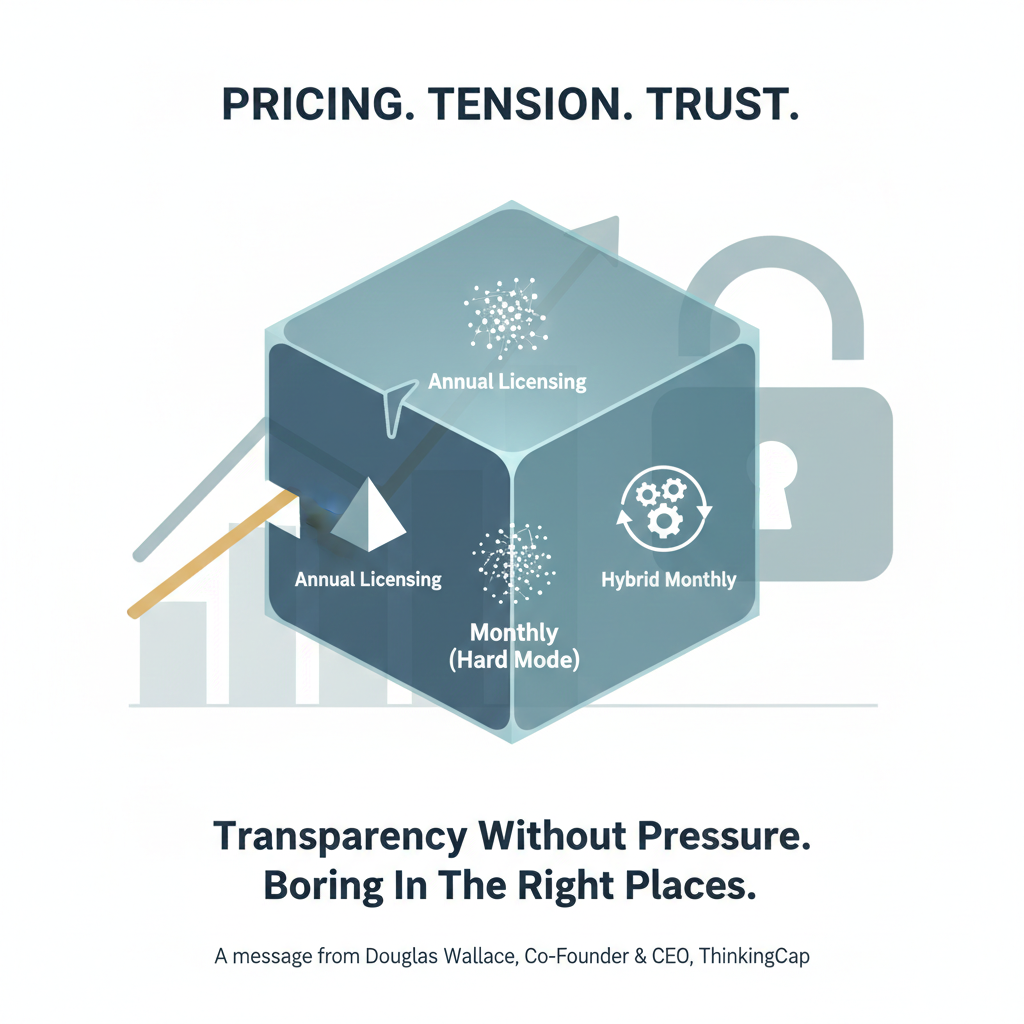
We use three models because uncertainty comes in different forms.
We do not believe there is one "correct" pricing model. What we see instead are three different kinds of uncertainty.
Annual Licensing: “We know who is here”
This is the easy one. You have a stable population—accreditation bodies, associations, or regulated workforces.
The Deal: You commit to a floor; you get our lowest per-seat cost. This is the most economical option for long-term users.
Monthly (Hard Mode): “We don’t know who is coming”
This is the no-holds-barred version of monthly pricing. You pay only for what happens each month.
The Reality: This model is intentionally unforgiving at low volume because flexibility has a literal cost. You are paying for the ability to be surprised.
Hybrid Monthly: “We know they’re coming, just not who”
This is where most rotating programs land. You commit to a larger monthly floor for a much better per-learner price.
The Truth: If the same learners use the system for months, annual licensing is cheaper. We will tell you that. The calculator will tell you that.
Bending over backwards for balance
For a long time, we let annual clients slide into cheaper tiers mid-term as soon as their usage crossed a threshold. It felt friendly, but it actually taught clients to underestimate their needs on purpose. It created a disincentive for honesty, which isn't healthy for a partnership.
So we changed the structure to protect our side, but then we bent over backwards to make sure it was fair to yours.
Now, we allow one no-penalty "true-up" mid-renewal. If you realize you should have bought at a higher level, you can jump to that level mid-term without a penalty—you just pay the difference you would have paid anyway. We always allow changes at the annual renewal, but this mid-term option brings the balance back. We took away what was unfair to us and added an option that ensures it's never unfair to you.
Even our contract is designed for balance
We don’t want to talk to your lawyers. We really don’t.
To avoid that, we’ve designed our contracts to be as close to "yes" as possible before they even reach your desk. We’ve already pushed the edge of what we can give in terms of protections and fairness. We pre-negotiated with ourselves so that we wouldn't have to spend weeks debating a simple sale.
We want to spend that time on your implementation, not on redlines.
What we actually want:
We want to talk about money once a year. If not less.
We want the rest of the conversations to be about learning, outcomes, automation, and data. We want pricing to disappear into the background. That only happens when trust exists on both sides.
Twenty years changes how you think about this. It’s long enough to see pricing fads come and go, and long enough to know that clarity beats novelty every time.
We are not trying to be the cheapest LMS. We are trying to be fair, transparent, and boring in the right places, so the contract is never the reason you don't pick us.
So go ahead and pick us already :-)
Signed,
Douglas Wallace Co-Founder and CEO
No More Hide-and-Seek
Our baseline pricing is now public and predictable. Compare our Account-based and Activity-based models to see which fits your learner flow.
View Our 2026 Pricing



 sales@thinkingcap.com
 1-416-977-4675